
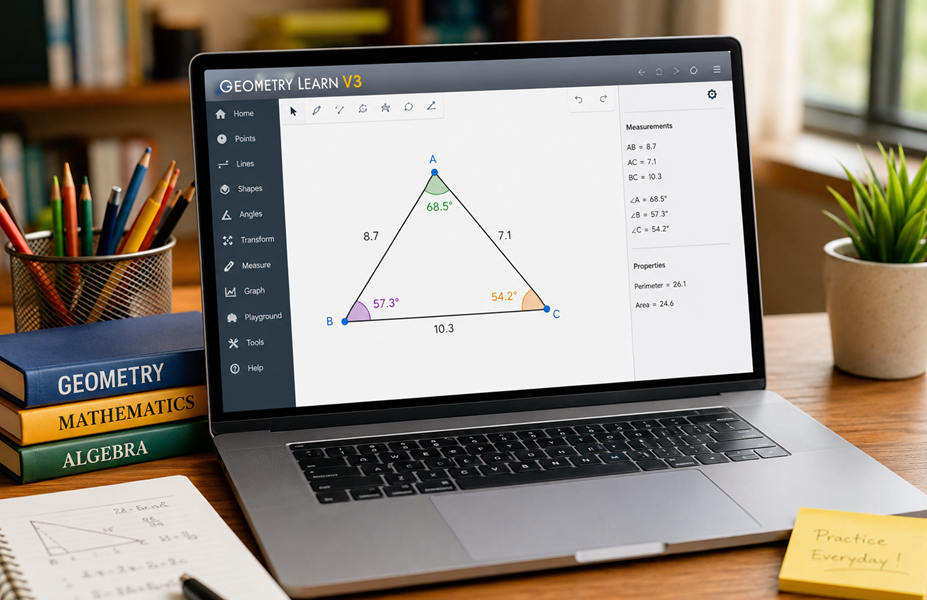
Geometry Learn V3: Everything You Need to Know in 2026
Geometry Learn V3 sounds like it might just be a software update. Version 3 of something. Maybe an app you’d install once and forget about. That’s a reasonable guess based on the name alone. But it’s not really that.
It’s a browser tool for learning geometry. You drag shapes around with your mouse. You rotate angles, stretch triangles, and watch the numbers change. No printed diagram that just sits there.
Most people typing this into Google aren’t searching for the tool itself. Not really. They’re searching because geometry class never showed them why a formula works, just that it does. So that’s what this guide is for. What it is, how to actually use it, which topics it covers well, and a couple of honest warnings most other pages skip.
What Is Geometry Learn V3?
Take away the marketing words and here’s what’s left: an interactive geometry tool. It runs in the browser. Nothing to install. Grab a corner of a triangle, drag it, and the area recalculates on the spot. Rotate an angle and watch it slide from acute to obtuse right in front of you.
That’s the gap between reading a formula on a page and actually watching it happen.
The “V3” part just means it’s the third round of the tool. Probably better on phones. Cleaner layout. More topics than whatever version came before it. Nothing secretive about it. A few sites online write about it like it’s some hidden product with a mystery behind it. It isn’t.
Why It’s Becoming Popular
A few reasons this term has picked up traffic lately.
Kids who grew up scrolling and tapping struggle more with flat textbook pages than students did a decade ago. That’s just where things are now. Homeschooling has grown too, and parents want something free. No download, no card number. Teachers want a thing they can throw on a projector. Nothing to license, nothing to fiddle with five minutes before the bell rings.
None of this is specific to one product. It’s a bigger shift toward hands-on, visual math tools in general. This name just happens to be catching search volume right now. It’s easy to find, and it works the second you open it.
Key Features
A lot of articles stop at vague words like “engaging” and “interactive.” They never say what that actually means. Here’s the real list.
You can move points and stretch sides. The area or perimeter updates as you go — no stopping to recalculate by hand. There are angle tools too, built for getting a real feel for complementary, supplementary, and vertical angles. That beats trying to remember which label goes with which picture.
Some versions walk you through proofs one step at a time, instead of showing the finished version. Honestly, that’s closer to what’s expected on an actual exam. Feedback is immediate as well, so a wrong answer gets flagged right away, not a week later when graded homework comes back. And it runs on a school Chromebook just as well as it runs on a home laptop — which sounds minor until you’ve tried installing something on a locked-down school device.
How to Use Geometry Learn V3
You don’t need a tutorial for this, honestly. Pick whatever topic you’re weakest in. Angles or triangle basics, usually, since those show up again and again later on.
Here’s the trick: play with the shape before you look at the formula. Drag a point around. Guess what should happen to the area or angle. Then check the real formula and see how close your guess landed.
Once that feels easy, move to something harder and repeat.
This order matters more than people think. Reading the formula first trains your brain to memorize it. Playing with the shape first trains it to understand what’s happening — and that sticks around a lot longer come test day.
Topics You Can Practice
Points, lines, and planes come first. These are the undefined terms every later proof quietly leans on. After that: angles — complementary, supplementary, vertical, adjacent.
Triangles come next. Isosceles, equilateral, scalene, right triangles. Then quadrilaterals and polygons, where perimeter, area, and interior angles all live. Circles get their own space too — radius, diameter, circumference, arc length. There’s basic coordinate geometry as well, for reflections, rotations, and translations, if you’re further along.
You don’t need all of this at once. Start with whatever’s tied to your current homework, or whatever’s tanking your test scores.
Geometry Learn V3 vs. Just Using a Textbook
| Factor | Geometry Learn V3 (Interactive) | Traditional Textbook |
|---|---|---|
| Feedback speed | Instant | Delayed, until graded |
| Watching a shape change | Yes, live | No, static diagrams only |
| Cost | Free or low-cost | Often $50–$150 per book |
| Installation needed | None, browser-based | N/A |
| Best suited for | Visual, hands-on learners | Learners who prefer structured reading |
| Works offline | Limited | Full |
Neither one wins outright, if I’m being honest. A lot of students end up doing both. Explore the concept interactively first, then read the textbook version afterward. That’s how you lock in the vocabulary and proof style teachers actually grade on.
Tips for Better Learning
Don’t skip the “why” part. Watching a number change while you drag something feels satisfying. It’s easy to move on without asking why the formula lands there in the first place.
Try the same idea across two different shapes. Understanding “area” only inside rectangles doesn’t automatically carry over to triangles or circles. That trips up more students than you’d expect.
Time yourself once in a while too. Interactive practice can make you fast at exploring. But it can also make you slow the moment real exam pressure hits and the hints disappear.
Use problems from your actual textbook or worksheet too, alongside the built-in exercises. Not instead of them. That way the wording on your real test doesn’t catch you off guard.
Is Geometry Learn V3 Safe to Use?
Do a couple of basic checks before you sink real time into this. Double-check you’re on the actual official site — a few copycat pages with near-identical names have shown up. Don’t hand over more personal information than an account strictly needs, if it even asks for one.
Teachers thinking about assigning it should check their school’s approved-software list first. That policy shifts a lot from one district to the next.
This is still a fairly new platform. What’s written about it online is inconsistent depending on which site you land on. So treat it as a supplement to real instruction for now. Not the only thing you’re relying on. At least until it’s been around long enough to build a track record.
Common Mistakes to Avoid
Memorizing a formula without understanding the shape underneath it is a common trap. It falls apart the second a question rotates or resizes that shape in a way you didn’t expect.
Rushing into proofs before the basics are solid is another one. Points, lines, angles — that foundation matters more than students realize, and proofs lean on it hard.
Only practicing “textbook-perfect” shapes is a third trap. Real exams love throwing in irregular or rotated versions, specifically to catch students who only memorized the clean picture.
And skipping the cross-check — never running the numbers by hand after exploring on screen — lets small gaps go unnoticed. They usually show up later, on a graded test.
Frequently Asked Questions
Is Geometry Learn V3 free to use? Most versions are free through the browser. Exact features can shift a bit depending on which site or version you land on.
Do I need to download anything? No. It runs entirely in the browser, so there’s nothing to install on a laptop, Chromebook, or tablet.
Is it good for beginners? Yes, arguably better than a textbook for beginners. You get to poke at a shape before you’re expected to already know the formula behind it.
Can teachers use it in class? Yes. Many teachers project it during lessons so the whole room can watch a shape change live, instead of imagining it from a flat diagram.
Does it replace a math teacher or textbook? No, and it isn’t trying to. It works best as a supplement that builds intuition alongside real lessons, homework, and teacher feedback.
What age group does it suit best? Mostly middle school through early high school. Younger kids exploring basic shapes and older students reviewing before exams can both get something out of it.