Afruimwagen: Complete Guide to Clearing Trolleys
Afruimwagen is a Dutch word for the carts and trolleys used to clear, collect, and haul items around a workplace. If you’ve come across it and had no idea what it meant, that’s fair — it’s not exactly common English.
Picture a restaurant during a lunch rush. Someone needs to clear dirty plates, glasses, cutlery, and leftovers off the tables, over and over, without turning the dining room into an obstacle course. That’s basically what an afruimwagen does.
You’ll find one in cafeterias, hotels, catering companies, hospitals, and offices — anywhere staff are constantly moving stuff around. Calling it “just a cart with wheels” undersells it, though. The whole design exists to answer one question: how do you move a lot of items safely, in one go, without wearing your staff out?
This guide covers what an afruimwagen actually is, how it works, where it’s used, the main types available, and how to pick and maintain the right one for your workplace.
Where the Word Afruimwagen Comes From
Split it into its Dutch parts and the meaning is pretty obvious. Afruimen means to clear away or tidy up, and wagen is just a cart or vehicle. Put together, an afruimwagen is “a cart for clearing things away” — exactly what it does.
What that looks like in practice depends a lot on where the afruimwagen is being used. A restaurant might want a trolley with three or four open shelves for stacking dishes and trays. A commercial kitchen usually cares more about whether it’s stainless steel and how quickly it can be hosed down.
You’ll also come across the word used more loosely online, for general transport or material-handling carts that have nothing to do with dishes at all. That’s part of why it shows up in conversations about agriculture and warehousing too, not just hospitality.
How Does an Afruimwagen Actually Work?
There’s nothing mysterious about it. Someone loads the afruimwagen, wheels it wherever it needs to go, unloads or sorts what’s on it, and brings it back for the next round.
The whole point is cutting down on wasted trips. Instead of a staff member carrying four plates back to the kitchen, then coming back for glasses, then again for trays, they load everything onto one afruimwagen and do it in a single pass.
Roughly, the process goes:
- Collect items from the work area.
- Sort them by type, or by where they’re headed next.
- Wheel the loaded cart across the floor.
- Unload and separate everything at the destination.
- Clean the cart if it needs it.
- Bring it back and start again.
Nothing complicated, but on a busy shift, it adds up to a noticeable difference in how smoothly things run.
Where You’ll Actually Find
Hospitality gets most of the attention here, but an afruimwagen really isn’t limited to that one setting.
Restaurants and cafés rely on clearing carts to collect used tableware, trays, and glasses. Separate shelves make it much easier to keep things sorted while clearing a full section of tables.
Hotels use them in restaurants, breakfast rooms, and conference spaces — anywhere food service runs on a rolling basis throughout the day.
Schools and canteens move an enormous number of dishes and trays every day, and a decent trolley makes the return trip to the dish pit far less of a slog.
Catering companies and event staff lean on mobile trolleys during weddings, conferences, and buffets, where a huge amount of tableware needs clearing in a short window.
Healthcare and care facilities use utility and service carts too, though what they’re made of and how they get cleaned depends heavily on the job.
Warehouses and general workplaces use a broader style of utility cart for supplies, tools, and boxes.
Different settings, same underlying idea: the afruimwagen turns repeated, scattered movement into something more organized.
What Actually Makes a Good Afruimwagen
Not every clearing cart pulls its weight, and what counts as “good” depends on your specific workload. A few things worth paying attention to:
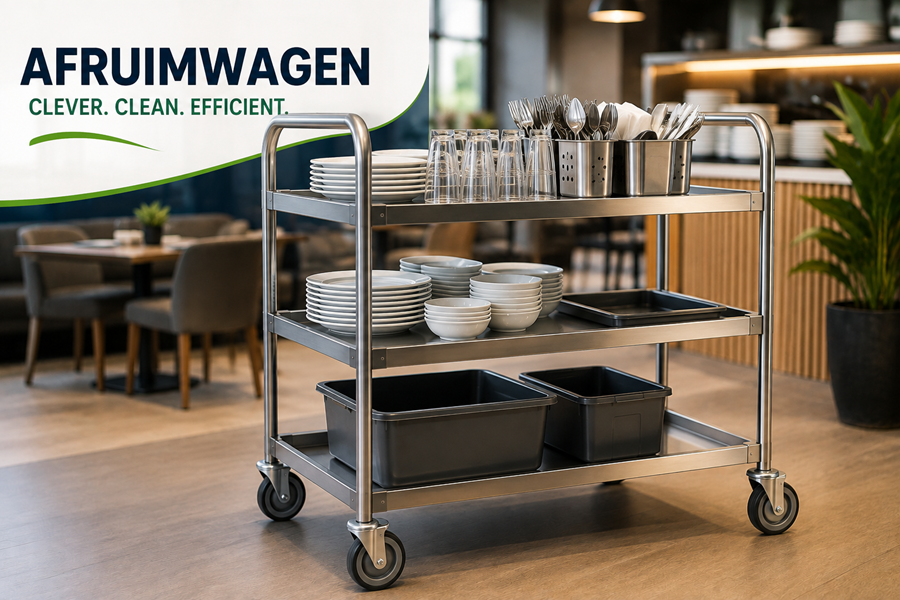
Construction. Something used every single day needs a frame built to take it. Stainless steel is common in professional food service because it holds up and is easy to clean.
Shelf layout. How many shelves you have, and how far apart they’re spaced, changes how much you can move at once. A small operation might get by fine with two shelves; bigger places often want three or four.
Wheels. This one gets overlooked constantly, but it shouldn’t. A fully loaded cart needs to stay stable while moving, and swivel casters make a real difference in tight kitchen corridors.
Handle placement. A handle positioned well gives staff actual control when pushing or pulling — it matters more than people expect once the cart’s been in use for a full shift.
Cleanable surfaces. Smooth surfaces without awkward corners save real time on cleaning. In food service, this should probably outrank “looks nice.”
Sensible capacity. Bigger isn’t automatically better. Match the size to your actual average load, not the busiest day you can imagine.
The Main Types of Afruimwagen You’ll Come Across
There’s no single design that fits every workplace, which is why there’s this much variety.
Open-shelf clearing trolleys are simple and practical, with multiple open levels — good for quick access when staff don’t want to fuss with lids or compartments.
Tray clearing trolleys are built specifically around trays, making them a natural fit for self-service restaurants and institutional dining halls.
Waste-sorting trolleys come with built-in buckets or containers so waste gets separated as items are cleared, instead of sorted out later.
Stainless-steel service trolleys are popular in professional kitchens for their durability and easy cleaning, and suppliers usually offer them with a range of shelf setups and accessories.
Heavy-duty utility carts are built for tougher material-handling work, where the loads are heavier than your average afruimwagen needs to handle.
Why Bother With an Afruimwagen At All?
The real benefit isn’t the cart itself — it’s what changes in the workflow once you’re using one properly.
Clearing gets faster, since staff move several items per trip instead of walking back and forth. Things stay more organized, because separate shelves or containers keep item types from getting jumbled together.
There’s less walking overall, and dining or working areas stay tidier when dirty items get removed promptly. Models with dedicated waste containers handle sorting as you go, which saves a step later.
Commercial equipment suppliers tend to highlight the same handful of advantages — speed, hygiene, ergonomics, easier maneuvering — and it’s easy to see why those keep coming up.
Afruimwagen vs. a Regular Utility Cart
These two get confused a lot, but they’re built with different jobs in mind.
A general utility cart is meant for general transportation — boxes, tools, supplies, whatever needs moving around a workplace. An afruimwagen is more specialized, built specifically around collecting and organizing.
| Feature | Clearing Trolley (Afruimwagen) | General Utility Cart |
|---|---|---|
| Main purpose | Clearing and collection | General transportation |
| Typical setting | Hospitality, food service | Offices, warehouses, workshops |
| Shelf design | Often built for dishes and trays | General-purpose |
| Waste separation | Common on some models | Depends on the model |
| Hygiene focus | Usually a priority | Depends on the job |
| Typical materials | Stainless steel, plastic, metal | Plastic, metal, steel |
At the end of the day, the right pick comes down to what you’re actually moving — not just how much you’re willing to spend.
How to Actually Choose the Right Afruimwagen
Skip the catalog browsing for a minute and think through your actual workflow first.
Start with your space. Measure doorways, corridors, kitchen entrances, and any tight turns the afruimwagen will need to navigate. A trolley that moves beautifully through an open dining room can be a real headache in a narrow hallway.
Think about what it usually needs to carry. Mostly trays and plates? A tray-focused design makes sense. Load changes a lot day to day? Go with something more flexible.
Actually test the wheels, not just the frame. A cart that pushes easily when empty can behave completely differently once loaded.
Put cleaning near the top of your list, especially in food service, where awkward corners become a daily annoyance.
Don’t ignore ergonomics either. Handle height, overall weight, and how smoothly the wheels move all add up over a full shift.
And resist the urge to buy the most expensive model on the list. A smaller operation is usually better off with something compact than a massive commercial unit it’ll never fully use.
Stainless Steel or Plastic Afruimwagen — Which One?
Both have a place, depending on what you need.
Stainless steel is the standard in professional kitchens — it’s tough, it lasts, and it takes regular cleaning without complaint. Plastic is lighter, and works well where weight matters more than heavy-duty toughness.
Worth thinking through before deciding: expected workload, cleaning routine, durability needs, weight, budget, where it’ll be used, appearance, and storage space.
For a demanding commercial kitchen, stainless steel is usually the smarter call. For lighter work, a decent plastic trolley does the job just fine.
Mistakes People Keep Making When Buying an Afruimwagen
Going too big. An oversized trolley might look impressive on paper, but good luck storing it or steering it through a busy floor.
Ignoring the wheels. Cheap wheels make a loaded cart miserable to push and hard to control.
Shopping on price alone. The cheapest option rarely holds up under daily commercial use, and you end up paying for it twice.
Forgetting about cleaning. An overly complicated design turns routine cleaning into a chore.
Skipping the tape measure. Always check actual dimensions — the afruimwagen has to fit through the spaces it’ll be used in every day.
Not asking the people who’ll use it. Staff who push the cart every shift usually have real opinions about height, maneuverability, and shelf spacing.
Keeping Your Afruimwagen in Good Shape
A little regular upkeep goes a long way here.
Clean it according to the manufacturer’s instructions and your workplace’s hygiene standards. Check the wheels now and then for trapped debris or uneven wear, and give the handles, shelves, and fasteners a once-over.
If one wheel starts behaving differently from the rest, deal with it early — left alone, it only gets harder to control. For stainless models, stick to appropriate cleaning products and skip anything abrasive.
A simple, consistent routine is almost always cheaper than fixing damage that could’ve been caught early.
What to Look For in a Genuinely Professional Afruimwagen
For commercial use, it comes down to five practical questions: Can it handle your normal workload without feeling unstable? Can staff move it around easily? Is it easy to clean? Does it physically fit the space it’ll travel? Will it hold up to daily commercial use over the long haul?
Suppliers currently offer plenty of variation in shelf count, materials, dimensions, and accessories — there’s no single “correct” afruimwagen configuration that works for every operation.
A Quick Word on Workplace Efficiency
More businesses these days are paying attention to small workflow improvements, because those little inefficiencies really do add up over time.
An afruimwagen is a good example of this playing out in an ordinary way. It doesn’t need to be flashy to matter — a well-thought-out cart shortens collection routes and makes daily movement more predictable. Looking ahead, expect more specialized designs, better ergonomics, and tighter integration with waste-separation workflows.
None of that changes the basic point: it’s not about how advanced the trolley looks. It’s about whether it solves a real problem on the floor.
Are Afruimwagens Only for Restaurants?
Not even close.
Restaurants are the most obvious example, but the underlying idea behind an afruimwagen applies anywhere items need collecting and moving efficiently — hotels, cafeterias, catering companies, institutions, healthcare settings, offices, and warehouses.
The design should always follow the environment, though. An afruimwagen built for food service shouldn’t be treated as the automatic answer for industrial material handling — load requirements, hygiene standards, and safety considerations look different from one setting to the next.
A Quick Afruimwagen Buying Checklist
Before committing to a purchase, run through this:
- Measure the route it’ll actually travel.
- Estimate your typical daily load.
- Figure out how many shelves you really need.
- Check the wheel quality carefully.
- Decide between stainless steel and plastic.
- Think about handle height and general ergonomics.
- Work out your cleaning requirements.
- Decide if waste separation is worth having.
- Confirm the trolley’s actual dimensions.
- Look into warranty terms and supplier support.
Going through this keeps the decision grounded in what you actually need, rather than a straight price comparison.
Frequently Asked Questions
What does afruimwagen mean? It’s Dutch for a clearing or service cart — wheeled equipment used to collect, organize, and move things like dishes, trays, waste, or general supplies.
What’s an afruimwagen actually used for? Mostly collecting and moving items efficiently. In hospitality that means dirty dishes, glasses, trays, cutlery, and waste. Other versions handle more general workplace transport.
Is an afruimwagen only a hospitality thing? No. Hospitality is the biggest use case, but similar carts turn up in cafeterias, hotels, catering, institutions, healthcare, and warehouses too.
Is stainless steel worth it for an afruimwagen? Usually, yes, especially for professional food service — it’s durable and easy to keep clean. The right material still depends on your workload, cleaning routine, and budget.
How do I pick the right afruimwagen for my business? Start with your actual workflow: typical load, available space, shelf setup, wheel quality, cleaning needs, and ergonomics. A trolley that genuinely fits your environment beats one picked purely for size or price.