
Innøve: Complete Guide to the Meaning, Principles, and Benefits
At first glance, Innøve looks like a modern brand name, but there’s more to it than that. The term has been appearing across blogs, business discussions, and online content, leaving many people wondering what it actually means and why it’s gaining attention. Unfortunately, most articles stop at broad descriptions without explaining the concept in a practical way.
In this guide, we’ll explore the meaning of Innøve, its origins, the principles behind the concept, its real-world benefits, and how it’s being applied across industries today. Whether you’ve come across the term in a business article, on social media, or in search results, this complete guide will help you understand what Innøve represents and why it continues to attract interest.
What Does Innøve Mean?
Strip it down and Innøve is a mashed-together word. It blends innovation, coming up with something new, with evolution, developing gradually over time. Put them together and you get a mindset rather than a definition. Steady, deliberate improvement instead of sitting around waiting for one big breakthrough to show up.
There’s a twist, though. The word already existed as a Norwegian verb long before this trend started, and it means something completely different: to practice, or drill something in, like a theatre troupe rehearsing lines before opening night. That older meaning has nothing to do with the concept people are searching for now. The newer trend simply borrows the look of the word. That “ø” gives it a clean, almost Scandinavian-design feel, without borrowing the actual definition. Good to know, if only so a random dictionary entry doesn’t throw you off later.
Why Is Innøve Gaining Attention Now?
Everyone’s expected to move fast these days. Learn the skill quickly. Scale the business overnight. Keep up with an industry that reinvents itself every six months, it seems. That kind of pressure rarely produces good work. Mostly it just produces burnout, and a lot of half-finished projects.
Innøve pushes back on that. Instead of forcing one dramatic overhaul, you make a small change, watch what happens, and build from there. It’s not a groundbreaking idea, honestly. It’s just a name for something a lot of entrepreneurs, students, and creators were already doing without calling it anything in particular.
Core Principles of the Innøve Mindset
There’s no certification here. No official body handing out badges. It’s a loose way of thinking that people shape around whatever they’re actually working on. Even so, a few ideas keep showing up wherever the term gets mentioned.
Small, consistent steps beat big, occasional ones. Improving one thing at a time usually works better than trying to fix everything at once. Reviewing what actually happened matters more than guessing again. Skip that step and you’re not really improving. You’re just changing things at random. The people affected by a decision should stay the focus, not the process itself. A system can be technically “optimized” and still miss the point entirely. And progress needs to hold up over months, not just produce a short-lived spike that fades once the initial motivation wears off.
How Innøve Works in Practice
Think about someone tweaking a recipe over time. They don’t rewrite the whole dish in one sitting. They swap one ingredient, taste it, maybe ask a friend what they think, then adjust again the next time they cook it. A few rounds later, the dish is noticeably better. There’s no single moment you could point to and say “that’s when it changed.”
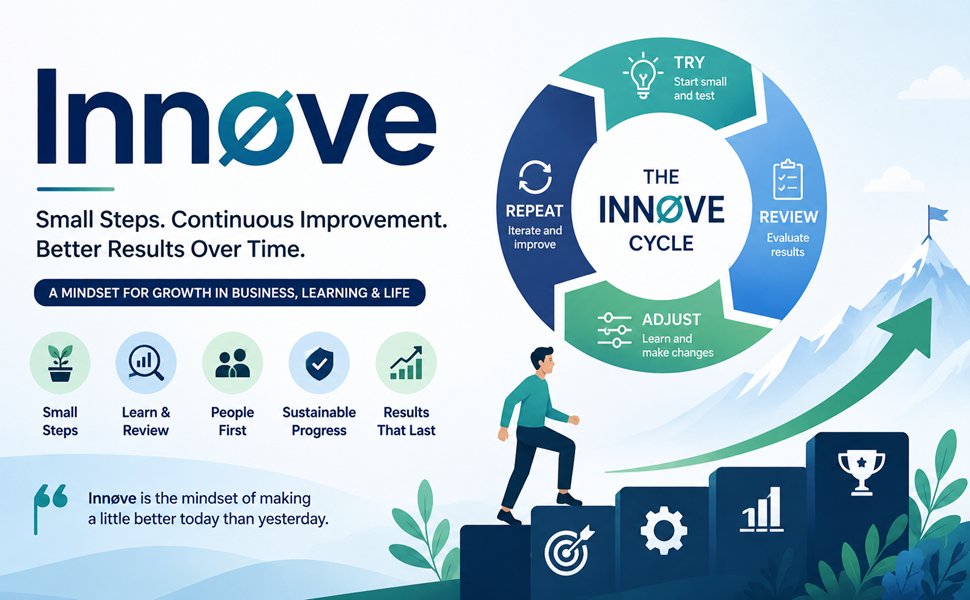
That’s basically the loop at the heart of Innøve. Try something small. See what happened. Adjust. Do it again. There isn’t much more to it than that.
Where Innøve Is Used
In Business
You don’t need to rewrite an entire strategy to apply this. Run an A/B test, collect feedback, tweak a feature slightly. Keep what works, quietly drop what doesn’t, move on.
In Education
Cramming a whole semester’s worth of material the night before an exam almost never sticks. Studying a little each day, and adjusting based on what’s actually landing, tends to hold up a lot better by the time finals roll around.
In Personal Development
New habits, better health, a skill you keep meaning to start. These tend to take root through small, repeatable actions rather than one ambitious resolution that quietly disappears by February.
In Content and Marketing
Creators do a version of this without necessarily naming it. Publish something, watch what resonates, refine the next piece based on that. Content strategy turns into an ongoing loop instead of one big bet you either win or lose outright.
Key Benefits of the Approach
Small steps feel less intimidating than big ones. People are more likely to actually start instead of endlessly planning. Each cycle also hands you a clear, specific lesson you can carry into the next attempt. No guesswork required. Because the bets are smaller, the losses are smaller too when something doesn’t pan out. That makes the whole process less risky than it sounds. It’s also easier to change direction mid-course when circumstances shift, since you were never locked into one giant plan to begin with. And gradual progress, in most cases, simply sticks around longer than a short burst of change that fades once the novelty wears off.
Where Innøve Falls Short
It’s not the right approach for everything, and pretending otherwise wouldn’t be honest. A security breach, a PR disaster, a sudden shift in the market. None of these leave room for a slow series of small experiments. You need to act now, not next Tuesday. This mindset also depends heavily on follow-through. Skip the review step a few times in a row and the small steps just stop adding up to anything. There’s a quieter problem too. Because progress is gradual, it’s genuinely hard to tell in the short term whether it’s working at all. That’s often exactly when people give up, right before it would’ve paid off.
Innøve vs. Kaizen vs. Agile
People tend to lump Innøve in with two more established ideas, so it’s worth separating them out.
Kaizen is a Japanese philosophy built around continuous improvement, mostly applied in business and manufacturing settings. Agile is more specific still. It’s a structured methodology built for software and project teams, complete with defined roles and rituals like sprints and retrospectives. This mindset doesn’t really compete with either. It’s looser than both, a general approach with no fixed structure, which is exactly why it stretches across business, education, and personal life without needing to be formalized into a system first.
How to Apply Innøve Step by Step
- Pick one clear, specific, and genuinely small goal.
- Break it into steps small enough that each one is actually doable.
- Review what happened after each step, honestly.
- Use that lesson to adjust the next step.
- Keep repeating the cycle. Consistency matters more than intensity here.
Signs the Innøve Mindset Is Working
Small changes don’t always feel like “real” progress, especially standing next to a big launch or a dramatic milestone. A few signs suggest it’s working anyway. Decisions start coming faster. Once reviewing small results becomes routine, you stop chasing the “perfect” plan and just start testing things. Setbacks feel smaller too. A failed attempt costs you a week, not a year, since each step was limited in scope from the start. Goals tend to stay realistic, since regular check-ins naturally correct overly ambitious plans before they spiral out of control.
The improvements also compound over time. Each change looks small on its own. After a few months, though, they create results that are difficult to achieve in one big leap.
Common Mistakes to Avoid
The idea sounds simple enough that people apply it loosely, and loose application tends to produce inconsistent results. Treating “small steps” as an excuse for having no plan at all is one common trap. The mindset still needs a clear goal. It just breaks that goal into pieces you can actually manage. Skipping the review step is another mistake. Without checking what actually happened, you’re just making random changes and calling it progress. Changing too many things in one cycle is a third problem. Adjust five variables at once and you’ll have no idea which one actually mattered. And quitting too early rounds it out, since gradual approaches take longer to show dramatic results. That can feel discouraging if you walked in expecting a quick win.
Frequently Asked Questions
Is Innøve a Recognized Framework?
No. It’s not academic, not peer-reviewed. Just an informal mindset built around gradual, consistent improvement.
Is It Useful for Small Businesses?
Yes, arguably more useful than for large ones. You don’t need a big budget or a large team to test small changes and see what sticks.
Do You Need to Pay to Use It?
No. It’s a way of approaching goals, not a product, a course, or a subscription you sign up for.
Is It Suitable for Beginners?
Yes. The core idea, small steps reviewed regularly, doesn’t ask for any prior experience to get started.
How Long Until You See Results With Innøve?
Depends on the goal. Most people notice something shifting within a few cycles, often somewhere around two to four weeks, since each cycle builds directly on the lesson from the one before it.

Related Posts

Afruimwagen: Complete Guide to Clearing Trolleys

Prizmatem: 9 Powerful Secrets You Need to Know