Best API Search Company’s Homepage (2026)
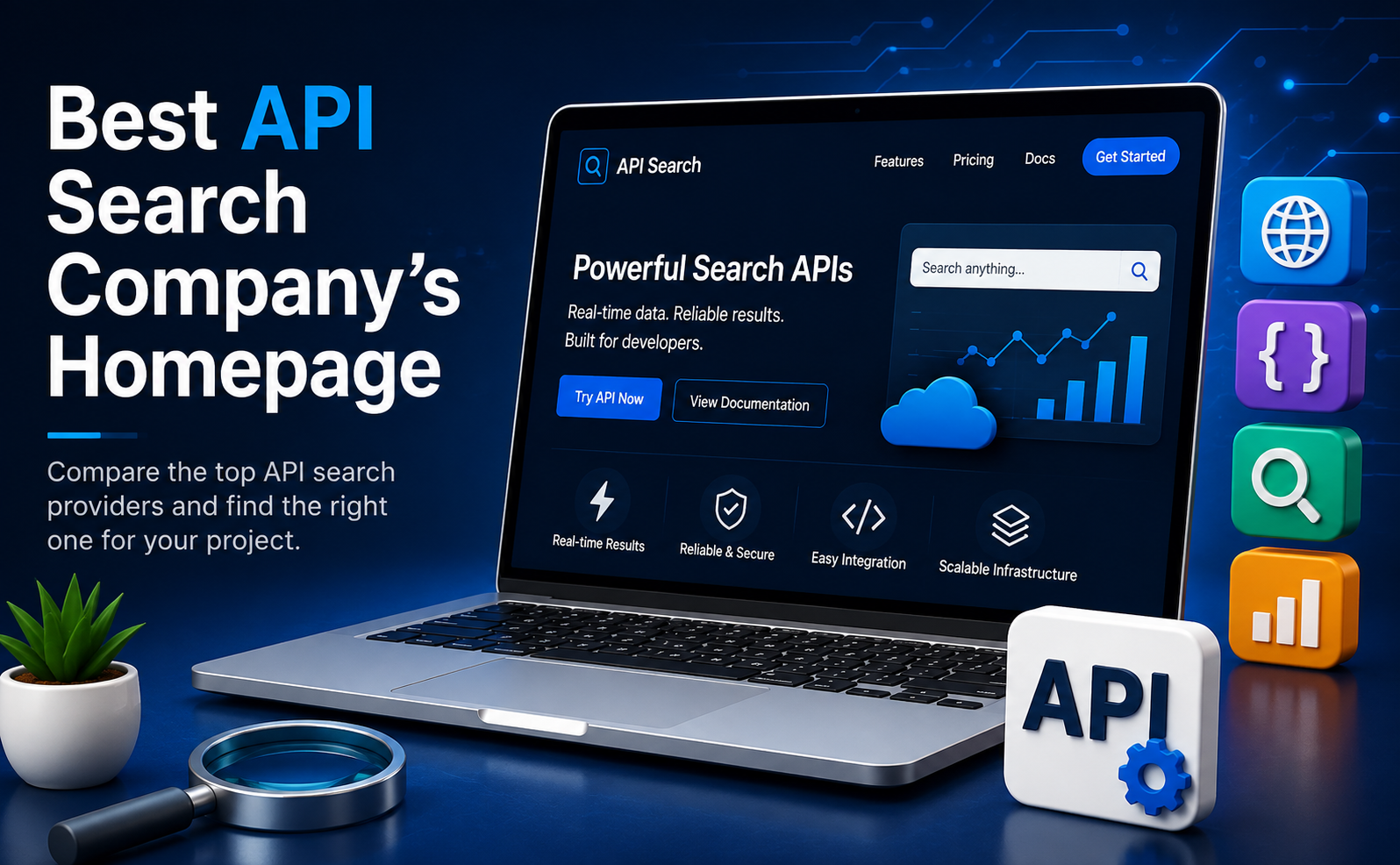
The best API search company’s homepage usually tells you more than the sales call that follows it. Before you sign up, get an API key, or read a single line of documentation, the homepage is already showing you how the company operates. Is the pricing real or hidden behind “contact us”? Does the demo actually work, or is it a screenshot pretending to be interactive?
I went looking for the best API search company’s homepage myself, and instead of just picking a winner, I dug into ten providers — a mix of SERP data tools and the newer AI-native search platforms — to see what each one gets right, where they trip up, and how a visitor is supposed to make sense of it all. Some of what I found surprised me. A few “big name” homepages are honestly worse than smaller competitors nobody’s heard of yet.
Best API Search Company’s Homepage Features
Before ranking anyone, it’s worth asking what “good” even means here. After looking at dozens of these pages over the years, a handful of things separate the useful ones from the noise:
- It tells you what the product does in one sentence — not “the world’s most powerful search infrastructure,” but something you could repeat to a coworker five minutes later.
- Pricing is visible, or at least a starting number is. If you have to book a call to learn what something costs, that’s rarely a good sign.
- There’s a link to real documentation somewhere near the top, not buried three menus deep.
- You can actually try the thing. A sandbox, a live query box, anything that lets you poke at real results before typing in a credit card number.
- It loads fast. This one sounds obvious, but you’d be amazed how many “speed-focused” APIs are hosted on homepages that crawl.
Keep those five in mind, because they come up again and again below.
Why the Best API Search Company’s Homepage Still Matters
You’d think none of this matters once you’re actually using the API — after all, you don’t revisit the homepage every time you make a request. But here’s the thing: the homepage is usually the only part of the product built by the same team that writes the marketing, sets the pricing, and decides how support tickets get handled. It’s a proxy for the company’s whole approach, not just its design taste.
A rushed, vague, or evasive homepage tends to predict a rushed, vague, or evasive support experience down the line. On the flip side, a homepage that’s upfront about limits, pricing, and rate limits usually belongs to a team that treats developers as the actual customer, not just a lead to convert. That’s really why comparing the best API search company’s homepage options is worth the twenty minutes it takes — it saves you from finding out the hard way, three months into a contract, that the company you picked doesn’t operate the way its landing page implied.
Ten Contenders for the Best API Search Company’s Homepage
1. Algolia
Algolia does the demo thing right — there’s a live search box on the homepage itself, and it’s genuinely fast. You get a feel for the product before reading a single bullet point, which is more than most competitors manage. Where it falls short: pricing takes a few extra clicks to find, and that small bit of friction is enough to push some technical buyers toward a competitor who just shows the numbers.
2. Typesense
Being open source shapes everything about this homepage — GitHub stars up top, a “try it yourself” sandbox, the works. The problem is the split between self-hosted and cloud isn’t explained clearly on the first screen, and newcomers end up confused about which version they’re even looking at.
3. Meilisearch
This one feels approachable in a way a lot of dev tools don’t. A sub-50ms demo, clean sections for hybrid and multi-modal search, nothing overwhelming. That said, it leans on buzzwords like “AI-native” without backing them up with a concrete example right away, which weakens an otherwise solid first impression.
4. Elasticsearch
As one of the oldest names in this space, Elasticsearch’s homepage carries real weight — deep documentation, enterprise case studies, the credibility that comes with years in the market. But that same history makes the page feel cluttered. If you just want a simple search API, wading through the product catalog is a lot to ask.
5. Exa
Exa is built specifically for AI applications, and it shows — the homepage explains embeddings-based semantic search in plain language, with clear endpoints for search, extraction, and research. What’s missing is a visible starting price. Everything is “custom,” which slows down evaluation for smaller teams who just want a ballpark number.
6. SerpAPI
There’s nothing subtle about SerpAPI’s pitch: multi-engine SERP coverage, JSON output, a price you can actually see. The design, though, hasn’t really moved since it first launched. Sitting next to newer AI-search competitors, it feels a bit stuck in time.
7. Tavily
Tavily leans into citation-ready answers for AI agents, and it shows sample response formats right on the page — a smart move for a technical audience. It does assume you already know what RAG and agent workflows are, so anyone newer to this space is left to figure it out on their own.
8. Firecrawl
Firecrawl gets straight to the point with a code snippet visible the moment you land — turn any page into clean, LLM-ready data, no scrolling required. Rate limits and scaling costs, though, don’t show up until you’re deep in the docs, and that’s the kind of thing that surprises teams once usage actually grows.
9. Bright Data
This is a homepage built for scale: a massive proxy network, several scraping products bundled together, enterprise SLAs front and center. It’s clearly written for enterprise buyers first, and smaller developers might feel like self-serve signup was an afterthought here.
10. Oxylabs
Oxylabs strikes a decent balance — SERP scraping with both raw HTML and parsed JSON, priced somewhere between “cheap” and “enterprise.” The trouble is the feature names sound a lot like everyone else’s. It’s genuinely hard to tell what makes Oxylabs different just from reading the homepage.
Best API Search Company’s Homepage Mistakes
If you’re trying to figure out what separates the best API search company’s homepage from a forgettable one, it usually comes down to a handful of repeated mistakes — patterns that showed up across almost every page I looked at, regardless of company size.
Vague hero copy is probably the biggest one. If a first-time visitor can’t explain what your API does after reading a single sentence, that sentence needs a rewrite. Being specific beats sounding impressive, every time.
Hidden pricing is close behind. Even a rough number builds more trust than “talk to sales.” Show something, then offer custom plans for bigger accounts later.
Some pages skip the demo entirely, which is a missed opportunity — developers want proof, not promises, and a small interactive box does more convincing than a wall of testimonials ever will.
Documentation buried under menus is another common one. Put the docs link where people can actually see it.
And then there’s speed. An API company that sells itself on performance shouldn’t make people wait for the homepage to load. Under 2.5 seconds should be the floor, not a stretch goal.
One more thing worth mentioning, since it’s easy to miss: some of these homepages repeat their target keyword phrase so often the copy stops sounding like it was written for a person. Write for the visitor first. Search engines tend to reward that anyway.
How to Choose the Best API Search Company’s Homepage
This really comes down to what you’re building, not which name you recognize.
Building product or app search? Algolia, Typesense, or Meilisearch are built for exactly that. Need search-engine data specifically? SerpAPI, Oxylabs, or Bright Data will get you there faster. Powering an AI agent or a RAG pipeline? Exa, Tavily, or Firecrawl fit better than traditional SERP tools. And if you’re running search at real enterprise scale, Elasticsearch gives you flexibility, while Bright Data brings the reach and support that come with a bigger price tag.
It also helps to think about your team’s size and how much engineering time you actually have to spare. A three-person startup usually gets more value out of a managed, self-serve product like Typesense or Meilisearch than a heavyweight enterprise platform that needs a dedicated engineer just to configure it. Bigger teams with dedicated infrastructure staff can absorb that complexity in exchange for more control.
Test the free tier before committing to anything. A homepage can only tell you so much — the real answer shows up once you run your own queries against your own data.
Final Verdict: What the Best API Search Company’s Homepage Actually Looks Like
If you strip away the branding and the buzzwords, the pattern is pretty consistent across every strong homepage in this list. It says what the product does in plain words. It shows a number, even a rough one, instead of hiding behind “let’s talk.” It lets you run a real query before you’ve handed over any payment details. And it gets out of your way fast enough that you’re reading documentation within a minute or two of landing on the page.
None of the ten companies here nail all five criteria at once — which honestly says more about how young this space still is than it does about any single provider. Algolia comes closest on demo and speed. SerpAPI wins on pricing clarity. Exa and Tavily lead on explaining the harder, newer concept of semantic search in a way that doesn’t require a machine learning background to follow. Pick based on what you’re building, not on which homepage looked the flashiest — flashy fades fast, and a good API doesn’t need to shout.
FAQs
What should I look for on an API search company’s homepage before signing up? The best API search company’s homepage usually gives you a clear one-sentence explanation of what it does, visible pricing, a working demo, and a direct link to documentation. If two or more of these are missing, take that as a warning sign.
Is a flashy homepage a sign of a better API? Not really. Design and API quality don’t always line up. Use the homepage to judge transparency and developer experience, then confirm actual performance with your own testing.
Which is better, SERP APIs or AI-native semantic search APIs? It depends on what you’re building. SERP APIs like SerpAPI or Oxylabs return search-engine-style results and metadata. AI-native APIs like Exa or Tavily understand meaning and intent, which usually works better for agents and RAG.
How much does pricing transparency actually matter? More than most people assume. Companies that hide pricing behind “contact sales” often end up costing more than competitors who just show their tiers. Open pricing tends to signal a confident, well-run product.
Should I trust homepage claims about speed and reliability? Treat them as a starting point, not proof. Always run your own tests on the free tier or sandbox before you commit to real-world usage.
Do smaller, lesser-known API search companies ever beat the bigger names? Sometimes, yes. A few of the smaller providers in this comparison were more transparent about pricing and limits than some of the bigger, more recognizable brands. Company size isn’t a reliable signal here — the homepage itself, and how honestly it’s written, tells you more than the logo does.