
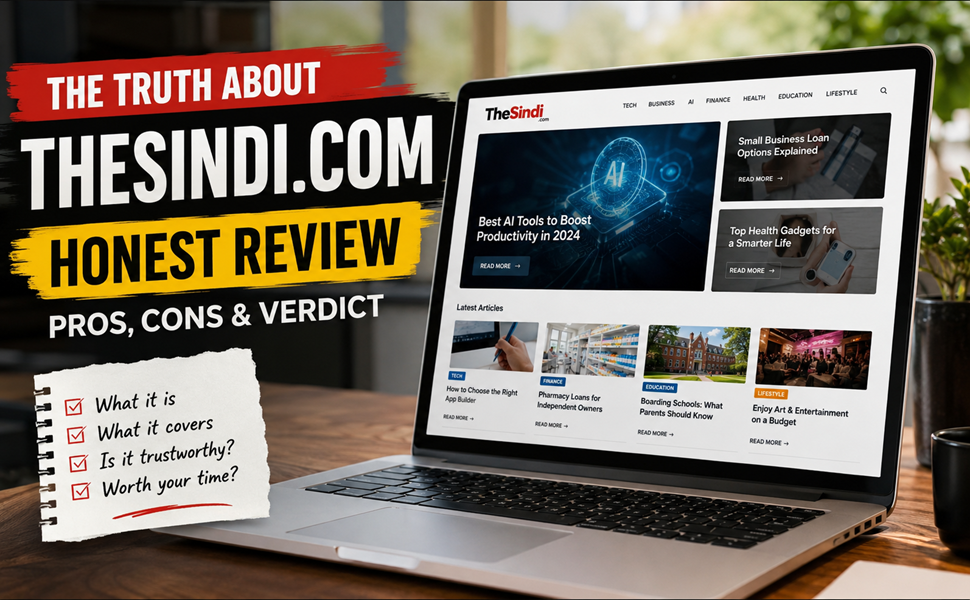
TheSindi com: Honest Review, Pros, Cons & Verdict
If you’ve come across TheSindi com, you’re probably wondering whether it’s actually worth your time or just another website filled with generic content. A quick search doesn’t help much—most results repeat the same basic description without explaining what the site offers, how reliable its content is, or who it’s really for.
In this guide, we’ll take a closer look at TheSindi com, exploring its content, categories, strengths, weaknesses, and overall user experience. Whether you’re thinking about visiting the site for the first time or simply want an unbiased overview, this review covers everything you need to know before deciding if it’s worth bookmarking..
Table of Contents
- What Is TheSindi com?
- How I Evaluated TheSindi com
- Quick Summary
- How TheSindi com Is Organized
- What’s Actually There When You Click Around
- What the Writing Feels Like
- Can You Trust TheSindi com?
- Pros and Cons
- How TheSindi com Compares to Similar Sites
- If You Use TheSindi com Regularly
- Who TheSindi com Actually Suits
- Final Verdict
- Frequently Asked Questions
What Is TheSindi com?
Take away the “who we are” copy and you’re left with a multi-niche content publisher. Nothing more complicated than that. No product, no tool, no login wall, no forum. Just a blog putting out articles across tech, business, AI, finance, health, education, and lifestyle, written for regular people rather than specialists in any of those fields.
Picture a shelf where a dozen unrelated topics sit next to each other, instead of a magazine built around one theme. Plenty of sites work this way and do just fine, so that’s not automatically a problem. What actually matters is whether the shelf is organized, and whether what’s sitting on it is worth reading. Which, really, is the whole point of this review.
How I Evaluated TheSindi com
Worth explaining the method before getting into the details, since most write-ups on this site skip it entirely. Instead of only reading whatever the homepage happened to link, I went through the main categories one at a time, opening articles at random within each section. Along the way, I paid attention to paragraph structure, whether claims were specific or vague, whether numbers showed up anywhere without a source behind them, and how consistent the tone stayed from one article to the next.
None of this was about hunting for typos or judging the design, though. What I actually wanted to know was whether the content helps someone make a decision, and whether it reads like a real editorial process was involved, rather than just volume for the sake of volume. Everything below comes from that.
Quick Summary
| Detail | TheSindi com |
|---|---|
| Type | Multi-niche content blog |
| Main Topics | Tech, AI, Business, Finance, Health, Education, Lifestyle |
| Cost | Free |
| Registration Required | No |
| Author Bylines | Not visible |
| Best For | Beginners and casual readers |
| Depth Level | Introductory to intermediate |
How TheSindi com Is Organized
Homepage does the usual thing. A pitch up top, then stat blocks, reader counts, category numbers, a pattern you’ve probably seen on plenty of newer sites trying to look established fast. Below all that is where the real content sits, split into sections like content creation, digital marketing, and event coverage, plus the broader categories people actually come here for.
The article library, however, is where things got more interesting for me. An interior door buying guide sits right next to advice on hiring full-stack developers. A casino bonus explainer, meanwhile, sits next to tips on evaluating boarding schools. Odd mix, no doubt about it. But it says something about the approach here, this isn’t a site trying to own one audience, it’s chasing a lot of small ones at once and betting enough of them come back.
What’s Actually There When You Click Around
Tech and AI
Probably the strongest part of the site, if I’m being honest. Some pieces are practical, picking an app builder, figuring out what threat intelligence software even does. Others, on the other hand, lean explainer, aimed at people who just want to understand why a full-stack developer costs what they cost, minus the lecture on programming languages they’ll never touch.
One thing I noticed is that these articles don’t oversell the tech angle. A piece on choosing an app builder doesn’t pretend every option fits every use case, it actually walks through when a no-code tool makes sense and when it doesn’t. Easy nuance to skip in generic content, and one of the few spots on the site where I saw it show up consistently.
Business and Money
Finance content leans toward decisions people are already in the middle of, not theory nobody asked for. Pharmacy loans for small independent pharmacies. Running rental properties with startup-level discipline. Reads more like practical guidance than formal investment advice, and it doesn’t try to pass itself off as a replacement for an actual accountant.
Health and Everyday Stuff
Wellness-adjacent topics, underarm waxing, medical alert devices without the sneaky hidden fees, sitting near lighter reads about enjoying art and entertainment without blowing a budget. Nothing clinical here, nothing medically authoritative, and to its credit, it doesn’t try to pretend otherwise.
In fact, none of the health-adjacent pieces I read made outright medical claims or pushed a product as some kind of cure. Instead, they stick to consumer-decision territory, comparing costs, explaining what a service actually includes, rather than drifting into advice that should come from an actual professional. Small thing, maybe, but a lot of thin health content doesn’t bother with that restraint.
Education Decisions
There’s a pattern running through the education pieces that I genuinely liked. Making a call without full information. How parents judge boarding schools. How students weigh study consultants before spending real money on one. Comparing free learning management systems without getting talked into an upsell. Held up better than I expected walking in, and it’s arguably where the site earns its keep the most.
Everything Else
Then a long stretch of oddly specific stuff. Gaming guides, CRM comparisons, shipping a car overseas, managing clients through Telegram. Multi-niche approach at full display, and also where the quality dips the most from one piece to the next, probably because it’s genuinely hard to hold a consistent standard across so many unrelated micro-topics at once.
What the Writing Feels Like
Plain English, mostly on purpose. Short paragraphs, barely any jargon, a tone closer to a friend explaining something than a formal reference you’d cite somewhere. Works in the site’s favor if dense writing usually makes you close the tab halfway through.
There’s a tradeoff though. Writing accessibly across this many topics means individual articles rarely go deep enough to replace an actual specialist. Beginner overview? Fine, you’ll get it. Expert-level detail? Probably not, you’ll end up searching elsewhere anyway. To be fair, most general-interest blogs run into this same wall, it isn’t unique to this one.
Can You Trust TheSindi com?
Nobody else covering this site seems willing to just say it outright, so here it is. TheSindi com works like a general-interest blog, not a fact-checked publication with named experts standing behind every piece. Even so, that doesn’t automatically make it unreliable, the same rule applies here as with most independent content sites out there.
Low-stakes stuff, how-tos, comparisons, lifestyle tips, it’s a decent starting point. Anything touching money, health, or legal decisions, treat it as a first read rather than the final word, and go check specific claims against a primary source before acting on them. Good practice with any blog, honestly, not a knock unique to this one.
Pros and Cons
| Pros | Cons |
|---|---|
| Free access, no paywall | No visible author bylines or credentials |
| Wide, genuinely varied topic coverage | Some articles feel thin or generic |
| Clean, mobile-friendly formatting | Depth is inconsistent across sections |
| No forced sign-up to read | Site identity feels a little unsettled |
| Decision-focused content in several categories | No visible fact-checking or editorial process |
How TheSindi com Compares to Similar Sites
Against a single-niche blog, it trades depth for range. Don’t expect an exhaustive deep-dive, expect a quick, understandable answer across a much wider spread of topics. Against a bigger, established multi-topic publisher, on the other hand, it’s still early on, fewer bylines, less transparency, a smaller archive overall. Overall, somewhere in the middle is where it lands. More useful than a thin content farm, not quite a fully built-out knowledge hub yet, though it’s clearly headed that way.
If You Use TheSindi com Regularly
Treat it as a jumping-off point, not the destination. Get oriented on a topic fast, jot down whatever specific numbers or claims actually matter to you, then go check those details elsewhere before leaning on them for anything important. Used like that, it’s a genuine time-saver rather than a risk.
Who TheSindi com Actually Suits
Casual readers who’d rather get a simple explainer than wade through jargon nobody asked for. People sorting through everyday decisions, loans, schools, tools, services, wanting a quick orientation before digging deeper somewhere else. Anyone who’d rather browse a bunch of topics in one place instead of bouncing between five different niche blogs. It’s less suited to anyone who needs citation-grade, expert-reviewed material.
Final Verdict
TheSindi com isn’t the mysterious platform most search results make it sound like. Instead, it’s a straightforward, multi-category content site doing what a lot of newer publishers do, casting a wide net, writing in plain language, filling out the archive slowly over time. Genuinely useful for quick, approachable answers across a broad range of everyday topics. Still, don’t confuse accessibility with authority. When something actually matters, use TheSindi com as a starting point, then go verify the details somewhere else.
Frequently Asked Questions
Is TheSindi com a legitimate website? Yes. Standard multi-category content and information blog. Not a scam, doesn’t ask for payment or sensitive info just to read an article. Structurally pretty close to a lot of independent blogs already out there.
What topics does TheSindi com cover? Mostly tech, AI, business, finance, health, education, and lifestyle, plus a long tail of niche subjects like gaming, travel logistics, and product comparisons.
Do I need to sign up to read articles on TheSindi com? No. Everything’s publicly accessible, no registration, no paywall.
Is the content on TheSindi com fact-checked by experts? No visible byline system, no named experts, so treat it like most independent blogs. Fine for general, low-stakes reading, worth double-checking anything involving money, health, or legal matters.
Is TheSindi com good for beginners? Probably its biggest strength. Writing’s deliberately simple and jargon-free, which makes it easy to get oriented on a topic fast, even starting from zero.
How does TheSindi com compare to other knowledge blogs? Covers more ground than most single-niche blogs, doesn’t go as deep as established, specialist publications. Somewhere in between, a decent starting point rather than the final word on anything.