Blazertje Meaning: Style, Fit & How to Wear It
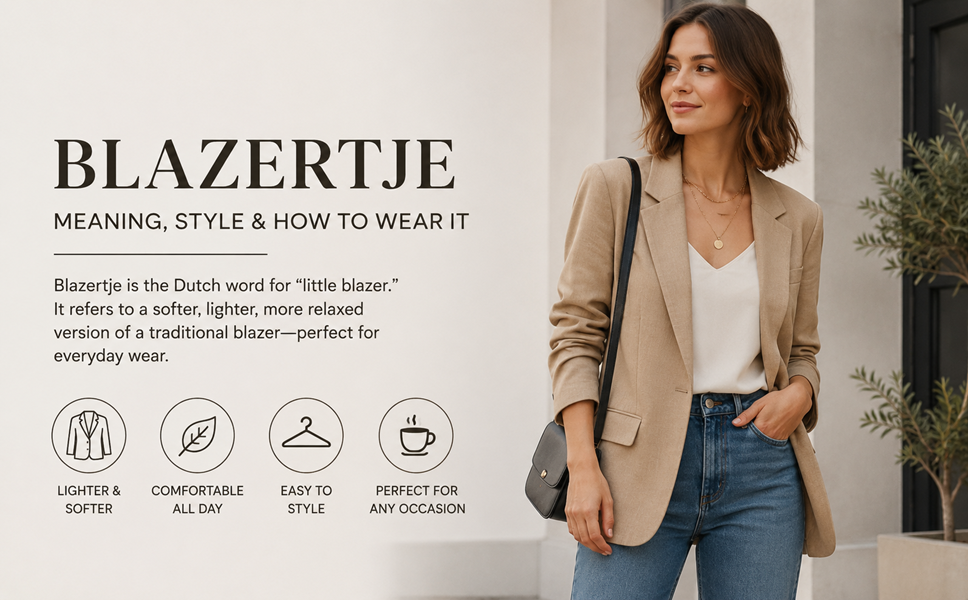
Ever come across the word “blazertje” and wonder what it actually means? It sounds like a fancy fashion term, but the idea behind it is surprisingly simple. Blazertje is a Dutch word built from “blazer” with the diminutive ending “-tje,” which roughly gives it the meaning of “little blazer.”
In fashion, though, things aren’t always that straightforward. The word can describe a blazer that feels lighter, softer, or more relaxed than a traditional tailored jacket. Sometimes it’s cropped, sometimes it’s loose, and sometimes it’s simply an easy-to-wear blazer that doesn’t feel overly formal.
So, if you’ve seen blazertje online and weren’t quite sure what people meant by it, you’re not alone. Let’s break down where the word comes from, what it usually looks like, how it differs from a regular blazer, and how people actually wear it.
So what does blazertje actually mean?
So we need to talk about grammar. When we are speaking Dutch we add the word “-tje” to the end of a noun. This makes the noun smaller. It sounds softer and friendlier. For example the word Blazer becomes blazertje. The same thing happens with the word jas it becomes jasje. That is all there is to it that is the thing with the word “-tje” in Dutch the word “-tje” makes nouns like Blazer and jas sound softer, like blazertje and jasje.
Where you actually see the word: Dutch-language fashion writing, mostly. English speakers run into it while looking up Dutch fashion terms, or scrolling style content that borrowed the word without translating it. There’s no consistent standard behind it, but a few traits keep popping up:
- Less padding than a traditional blazer
- Fabric you can wear all day without wanting to shrug it off by 3pm
- Shoulders that move with you instead of holding some stiff shape
Quick thing worth clearing up now rather than later: blazertje does NOT automatically mean cropped. People assume that a lot. It’s not a rule. Depending who’s writing, the word might just mean lighter or looser, nothing to do with length.
Picture it sitting somewhere between a cardigan and an actual suit jacket. Sharp enough for the office, relaxed enough that you’d grab it for a coffee run without thinking twice.
Blazertje vs a regular blazer vs a cardigan
One thing before the table: blazertje isn’t a standardized category like “blazer” or “cardigan” is. It’s a Dutch diminutive that picked up a vibe over the years — not something with a spec sheet. So read the table as “how the word usually gets used,” not gospel.
| Feature | Blazertje | Traditional Blazer | Cardigan |
| Structure | Semi-structured, soft shoulder | Fully structured, padded shoulder | Unstructured, no shoulder seam |
| Fabric weight | Light to mid-weight | Heavy wool, twill | Knit (wool, cotton, cashmere) |
| Formality | Smart-casual to business-casual | Formal to business | Casual |
| Closure | Single button or open-front | Structured buttons, lapels | Buttons or open knit |
| Best for | Everyday wear, hybrid work, travel | Interviews, formal meetings, suits | Weekend, layering, loungewear |
| Comfort/movement | High | Moderate to low | Very high |
Where did this word even come from
Blazers go back to 19th-century England — rowing clubs wore navy jackets with brass buttons so you’d know which club a guy rowed for. Over the next hundred-plus years the blazer wandered pretty far from that formal starting point, ending up in regular people’s closets.
Blazertje specifically? Harder to trace. It seems to have come out of Dutch and Belgian style writing at some point, as a looser way to talk about the blazer, but nobody can point to one article or one designer and say “there, that’s where it started.” What is obvious is that the word’s traveled well past the Netherlands now — mostly riding along as smart-casual dressing became normal pretty much everywhere.
What can a blazertje look like?
Since it’s not a fixed category, treat this as “things you’ll often see,” not a checklist:
- Often lighter fabrics — linen blends, cotton, lightweight wool
- Sometimes softer shoulders, less padding than a formal blazer
- Some are cropped or hip-length. Plenty aren’t.
- Lining and closures vary a ton from piece to piece — some have barely any lining, others more
- Neutrals (navy, camel, beige, black, gray) show up a lot, but florals and checks aren’t rare either, depending on season
How people actually wear one
Weekends. White tee, jeans, sneakers, done. Throw an oversized one over a tank top without even buttoning it and somehow it looks intentional. No idea why that trick works, but it does.
The office. Fitted or slightly tailored, navy or black or camel. Tailored trousers or a pencil skirt, something silk or cotton underneath, a flat or low heel. Polished, but not like you tried too hard.
Going out. Now you can have some fun — emerald, burgundy, something with a little drama in it. Leather leggings or tailored trousers, a simple top, heels or boots, jewelry if you’re in the mood for it.
Traveling. Linen or cotton earns its suitcase space because it layers both ways — over a tee when it’s hot, over a thin sweater when it’s not. Probably why it ends up in half the travel capsule wardrobes you see online.
Just… everyday. T-shirt, jeans, blazertje. That’s genuinely the whole formula. Takes almost no effort and still looks like you put thought into it.
Fit and proportions
Not about “fixing” your body, just about which cut suits which frame.
- Shorter torso — cropped or hip-length usually looks more balanced
- Longer torso — a slightly longer, fitted style evens things out
- Want more waist shape — look for a single-button cut with a bit of taper
- Prefer things relaxed — boxier’s totally fine, that’s just a different look, not a mistake
- Broader shoulders — unstructured tends to look less boxy than a padded shoulder would
- Planning to layer over a sweater once winter hits — size up now, don’t fight yourself in December
Best fabrics, and why
| Fabric | Best For | Notes |
| Linen / linen blends | Spring & summer | Breathable, naturally textured, wrinkles easily |
| Cotton twill | Everyday, year-round | Durable and easy to maintain |
| Lightweight wool | Fall & office wear | Holds shape, warm without bulk, polished |
| Silk / cashmere blends | Evening | Soft drape, but needs delicate care |
| Ponte knit | Travel | Stretchy, wrinkle-resistant, low-maintenance |
Taking care of it
Depends entirely on what it’s made of, honestly. Linen and cotton can go in the wash on a cold, gentle cycle — or hand-wash if you’re careful — then hang dry so nothing shrinks. Wool’s a different animal: dry clean it, or spot clean when you can get away with it, and hang it on a padded hanger so the shoulders don’t lose their shape sitting in the closet. Knit or ponte pieces usually survive a delicate machine cycle fine, but lay them flat to dry — hang them wet and gravity will stretch them out on you. And don’t cram the closet so tight things get crushed. That kills a shoulder line faster than almost anything. Storing it for a whole season? Grab a garment bag.
Blazertje, cropped blazer, petite blazer, unstructured blazer — what’s actually different
People use these words like they’re interchangeable. They’re really not.
- Blazertje — about the overall feel, lighter and softer, not tied to a specific cut.
- Cropped blazer — purely about length, hits above the hip no matter what it’s made of.
- Petite blazer — proportioned for a shorter frame, often with shorter sleeves, shorter body, adjustments across the board.
- Unstructured blazer — about how it’s built, minimal padding and lining regardless of length.
A piece called a blazertje could easily be cropped, petite, and unstructured all at once — cropped-and-unstructured together is a pretty common combo, actually. But by itself, the word’s more of a vibe than a spec.
Men wear these too
Same idea for guys — lighter, unstructured jackets in cotton, linen, or lightweight wool, thrown over a T-shirt or an open-collar shirt. Good for weddings, summer parties, or any office with a relaxed dress code where a full suit jacket would feel like way too much.
What to actually check before buying one
- Shoulder seam sits right at your shoulder — not hanging past it, not pulling in
- Sleeves stop around your wrist bone, with room to push them up if that’s your thing
- Check the fabric label — natural fibers and decent blends usually hold up and breathe better than fully synthetic stuff
- Less lining = more breathable. More lining = more structure and warmth.
- Buttons close flat, no pulling or gapping across the chest
- Check the stitching — even, reinforced seams usually mean it’ll actually last a while
- Figure out what you need it for (office, travel, casual) before you even look at price
- Check the care label first if dry-clean-only is a dealbreaker for you
- Care about sustainability? Organic cotton or recycled/deadstock fabric is worth hunting for
Questions people usually ask
What does blazertje mean in English? Literally “little blazer.” The “-tje” is just how Dutch makes something diminutive.
Is it the same as a regular blazer? Not exactly — usually lighter, less structured. But since there’s no official definition, it really depends who’s using the word.
Can you wear one to work? Yeah, especially a fitted one in wool or cotton twill with tailored trousers. Fine in most business-casual offices.
What’s the difference between this and a cardigan? A blazer-style piece keeps some tailored elements — lapels, a shaped front. A cardigan is knitwear, no tailoring like that.
Is the word Dutch or Belgian? Dutch in origin, though it’s used plenty in Belgium too, where Dutch is one of the official languages.
How do I know if mine fits right? Shoulder seam at your actual shoulder point, sleeves stopping around the wrist, and if it buttons, it closes without pulling anywhere across the chest or back.
Does blazertje always mean cropped? Nope. Gets associated with shorter styles a lot, but there’s no rule saying it has to be. Depending who’s using the word, it might just mean lighter or softer, not necessarily short.